Introduction
Airline Paper Cutlery: Buyer’s Guide for In-Flight Meal Service is written for B2B buyers who need a practical way to evaluate sustainable cutlery and paper-based food packaging suppliers. Airline paper cutlery must work inside a constrained service environment. Weight, hygiene, meal tray compatibility, wrapper format, passenger comfort, and documentation are all part of the buying decision.
In-flight meal service leaves little room for product failure. Cutlery must be packed efficiently, handled quickly by catering teams, fit meal trays, avoid sharp or uncomfortable edges, and support the airline’s sustainability narrative without compromising safety or service flow. A professional sourcing process should therefore look beyond product photos and unit price. It should define the application, confirm documentation, test samples under real conditions and compare suppliers using the same commercial assumptions.
This guide can be used by airline catering companies, procurement teams, onboard service managers, travel retail suppliers as a procurement checklist before requesting samples or approving a bulk order. It is also suitable as SEO content because it targets buyers who are already close to a commercial decision and need supplier-level answers rather than generic sustainability claims.
Why This Topic Matters Now
Sustainable foodservice packaging has moved from a marketing preference to a practical procurement requirement. Buyers are replacing conventional plastic items, reviewing paper sourcing claims and asking for clearer evidence around food-contact safety. For airline paper cutlery, the supplier conversation is now about performance, documentation and supply reliability at the same time.
Regulatory expectations are also becoming more detailed. In the EU, food-contact materials are expected to follow general principles of safety and inertness, and packaging policy is moving toward recyclability, clearer labeling and tighter control of substances of concern. In the United States, the FDA announced that PFAS-containing grease-proofing substances were no longer being sold for food-contact use on paper food packaging. These developments do not remove the need for local legal review, but they do show why buyers ask for stronger documentation.
The customer experience matters as much as compliance. Cutlery is handled directly by the consumer, passenger, guest or takeaway customer. If it bends too easily, has an unpleasant mouthfeel, carries unclear claims or arrives in weak packaging, the final customer rarely blames the supplier. They blame the food brand. For this reason, paper cutlery purchasing should be treated as brand protection as well as product sourcing.
The B2B Buying Framework
A disciplined buying framework begins with the intended use case. The buyer should define the food type, service model, packaging channel, destination market and expected monthly or annual volume. Only after these inputs are clear should the team compare supplier prices. Otherwise, two quotations may describe different products while appearing similar on the surface.
For this topic, the most important buying decisions are individually wrapped vs set format, tray size compatibility, weight and cube efficiency, passenger comfort, hygiene and handling, multi-route documentation. These should be converted into RFQ fields rather than kept as informal notes. A written RFQ lets the supplier confirm feasibility and gives the buyer a fair basis for comparing offers.
The best RFQ is specific but not closed-minded. Buyers can share a target specification and ask the manufacturer to recommend the closest standard option, a premium option and a cost-optimized option. This creates a useful discussion about performance and budget while still keeping the project controlled.
Product Specification Checklist
| Specification item | Buyer requirement | Verification method |
| Set composition | Define measurable acceptance criteria. | Verify through sample testing and repeat-order checks. |
| Wrapper dimensions | Define measurable acceptance criteria. | Verify through sample testing and repeat-order checks. |
| Napkin or sachet integration | Define measurable acceptance criteria. | Verify through sample testing and repeat-order checks. |
| Carton count | Define measurable acceptance criteria. | Verify through sample testing and repeat-order checks. |
| Galley storage efficiency | Define measurable acceptance criteria. | Verify through sample testing and repeat-order checks. |
| Food pairing by cabin class | Define measurable acceptance criteria. | Verify through sample testing and repeat-order checks. |
A product specification is the bridge between a catalogue item and a purchase order. For airline paper cutlery, the specification should cover the product itself, the packaging format and the way the item will be handled before use. Each point below should be checked at sample stage and again before repeat orders.
Buyers should keep approved samples, carton labels and artwork proofs together with the purchase specification. This gives both parties a shared reference if there is a quality claim, a customer complaint or a change request in the future.
Compliance and Documentation
| Documentation area | What to request | What to verify |
| Food-contact documentation | Request SKU-specific evidence. | Check scope, date, issuing body and applicability. |
| Hygiene controls | Request SKU-specific evidence. | Check scope, date, issuing body and applicability. |
| Destination-market requirements | Request SKU-specific evidence. | Check scope, date, issuing body and applicability. |
| Customer-specific packaging declarations | Request SKU-specific evidence. | Check scope, date, issuing body and applicability. |
| Traceability for catering supply chains | Request SKU-specific evidence. | Check scope, date, issuing body and applicability. |
Compliance documents should be requested early in the buying process. A buyer sourcing airline paper cutlery may need food-contact test reports or declarations, FSC documentation if responsible sourcing claims are used, BRCGS or comparable site-level quality evidence, PFAS-related documents where relevant and traceability information connected to the exact SKU.
Different documents answer different questions. FSC chain-of-custody documentation supports responsible paper sourcing claims. BRCGS Packaging Materials certification supports site-level quality, legality, product safety and authenticity systems. Food-contact documents address suitability for the intended food-contact use. PFAS declarations or reports address chemical risk and market expectations. These documents should not be treated as substitutes for one another.
The buyer should verify document scope, date, issuing party, product coverage and whether the document applies to the exact material and production site being used. Generic sustainability language is not enough for a retailer, airline, importer or foodservice chain that may need to defend claims to its own customers.
Commercial Planning: MOQ, Lead Time and Logistics
| Commercial factor | Why it matters | Buyer action |
| Forecast by route and season | Impacts landed cost or timing. | Compare under the same Incoterms and pack format. |
| Consistency across catering stations | Impacts landed cost or timing. | Compare under the same Incoterms and pack format. |
| Lead time reliability | Impacts landed cost or timing. | Compare under the same Incoterms and pack format. |
| Carton and pallet planning | Impacts landed cost or timing. | Compare under the same Incoterms and pack format. |
| Approved vendor continuity | Impacts landed cost or timing. | Compare under the same Incoterms and pack format. |
Commercial planning should include landed cost, not only factory unit price. For airline paper cutlery, carton quantity, pallet height, wrapper choice, retail pack format, private label artwork, sampling, testing and Incoterms can change the economics of the order.
MOQ should be discussed by SKU and by packaging version. A standard bulk spoon may have a different MOQ from an individually wrapped private label set. First orders also require more coordination than reorders because artwork, samples, documents and quality references need to be approved before production starts.
Lead time should be realistic rather than optimistic. Buyers should ask for normal lead time, peak-season lead time and the point at which production capacity must be reserved. Distributors and foodservice chains should share forecasts when possible so the manufacturer can plan raw materials and production slots.
Quality Control and Sample Approval
Quality control should connect the approved sample to repeat production. A good supplier keeps records for raw material receiving, line setup, in-process checks, finished product inspection, packaging integrity, carton labeling and traceability. The buyer does not need to inspect every record for every order, but the supplier should be able to explain how the system works.
For airline paper cutlery, practical quality checks usually include dimensional accuracy, rigidity, visual appearance, edge smoothness, wrapper integrity, carton condition and consistency against the approved sample. If the product will be used with dense desserts, hot meals, salads, airline trays or retail shelves, the sample should be tested in that exact context.
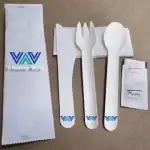
A signed pre-production sample is especially important for private label products. Artwork, pack count, barcode, label language, claim wording and carton markings should all be reviewed before bulk production. This prevents common disputes such as a technically correct product arriving in the wrong pack format or with incomplete labeling.
Supplier Comparison Scorecard
A useful supplier scorecard should include specification match, sample performance, documentation availability, certificate scope, communication quality, production capacity, packaging capability, lead time, logistics support and after-sales problem solving. Each supplier should be scored against the same assumptions.
The lowest price can be misleading if it hides a weaker material, lower carton count, unsupported claim, missing test report or different Incoterms. Buyers should compare quotes on the same pack count, same destination, same documentation requirements and same quality level. If a supplier cannot explain what is included in the price, the quote is not complete.
The supplier’s questions are also a signal. A serious manufacturer will ask about destination market, intended food contact, packaging artwork, annual volume, certification needs and delivery terms. These questions help protect the buyer from mistakes that may otherwise appear only after production has started.
Common Mistakes to Avoid
Most sourcing problems are predictable. They happen because the buyer and supplier did not define the product, documents, approval process or logistics clearly enough before production.
- Avoid ignoring tray fit. This risk can usually be reduced by writing the requirement into the RFQ, checking the sample under real service conditions and confirming the supporting document before the purchase order is finalized.
- Avoid choosing too bulky a pack. This risk can usually be reduced by writing the requirement into the RFQ, checking the sample under real service conditions and confirming the supporting document before the purchase order is finalized.
- Avoid underestimating wrapper tear performance. This risk can usually be reduced by writing the requirement into the RFQ, checking the sample under real service conditions and confirming the supporting document before the purchase order is finalized.
- Avoid failing to test during real meal assembly. This risk can usually be reduced by writing the requirement into the RFQ, checking the sample under real service conditions and confirming the supporting document before the purchase order is finalized.
- Avoid not planning for route-specific documentation. This risk can usually be reduced by writing the requirement into the RFQ, checking the sample under real service conditions and confirming the supporting document before the purchase order is finalized.
RFQ Questions for Suppliers
A strong RFQ should be short enough for the supplier to answer quickly and detailed enough to prevent assumptions. The following questions can be added to the enquiry form or sent with the first sourcing email.
- Which exact SKU, dimension and packaging format is being quoted?
- Which documents are available before sample approval and before shipment?
- What is the MOQ by SKU, artwork version and carton configuration?
- What is the normal lead time for first production and repeat orders?
- How are raw material batches, production batches and finished cartons traced?
- What changes require buyer approval before production?
Channel and Use-Case Planning
The same paper cutlery product family can require different configurations by channel. Retail buyers often need shelf-ready packs, barcodes, multilingual labels and consumer-facing claims. HoReCa buyers often need bulk cartons, hygienic wrapping and fast replenishment. Airline and catering buyers often need compact sets, route-ready documentation and efficient tray compatibility. Distributors need a core range that serves several customer types without excessive SKU complexity.
For airline paper cutlery, buyers should map the product to the real use case before locking in the SKU. A spoon for gelato, a set for an airline meal and a retail multipack for supermarkets may all be paper cutlery, but they are not the same sourcing project. Good suppliers help buyers separate these use cases and choose the right pack format for each.
A practical launch strategy is to begin with high-volume SKUs, gather customer feedback and then expand into specialized formats such as wrapped sets, private label cartons, dessert spoons, retail display boxes or customer-specific packaging. This reduces inventory risk and improves forecasting accuracy.
FAQ
Is paper cutlery suitable for all foods?
Paper cutlery can work very well for many meals, desserts and takeaway applications, but suitability depends on the exact design, board structure, food type, contact time and service conditions. Buyers should test samples with the actual menu item before bulk approval.
Should buyers request samples before ordering?
Yes. Samples help buyers evaluate strength, mouthfeel, dimensions, packaging fit, wrapper quality and customer experience. For private label projects, pre-production samples should also be checked against artwork and carton labeling.
What documents should be requested?
A professional documentation pack may include food-contact test reports or declarations, FSC documentation if an FSC claim is used, PFAS-free declarations when relevant, quality system certificates, product specifications and traceability information.
Does the lowest unit price usually mean the lowest cost?
Not necessarily. Landed cost includes carton efficiency, freight, duties, defects, claims, documentation gaps, lead time risk and inventory cost. A slightly higher unit price can be better if it reduces operational risk.
When should packaging artwork be finalized?
Artwork should be finalized only after the product specification, pack count, claim wording, barcode, label language and compliance requirements are agreed. Late artwork changes can delay production and increase cost.
Conclusion
Airline Paper Cutlery: Buyer’s Guide for In-Flight Meal Service should help buyers move from a vague product search to a structured sourcing process. The strongest purchasing decisions are made when procurement, quality, sustainability and marketing teams agree on the specification, documentation requirements, packaging format and commercial terms before the order is placed.
For buyers evaluating airline paper cutlery, the practical next step is to prepare a complete RFQ, request samples, check documents, test the product under real service conditions and compare suppliers on total value rather than unit price alone. This approach improves supply reliability, reduces compliance risk and creates a better experience for the final customer.